
Skip hire
Find the right skip.
Book with confidence.
4yd to 16yd skips for clear-outs, renovations and building work — delivered, left with you while you fill it, and collected on a day you choose.
- Delivery and collection in the price
- No collection date needed to book
- On the road? We arrange the permit
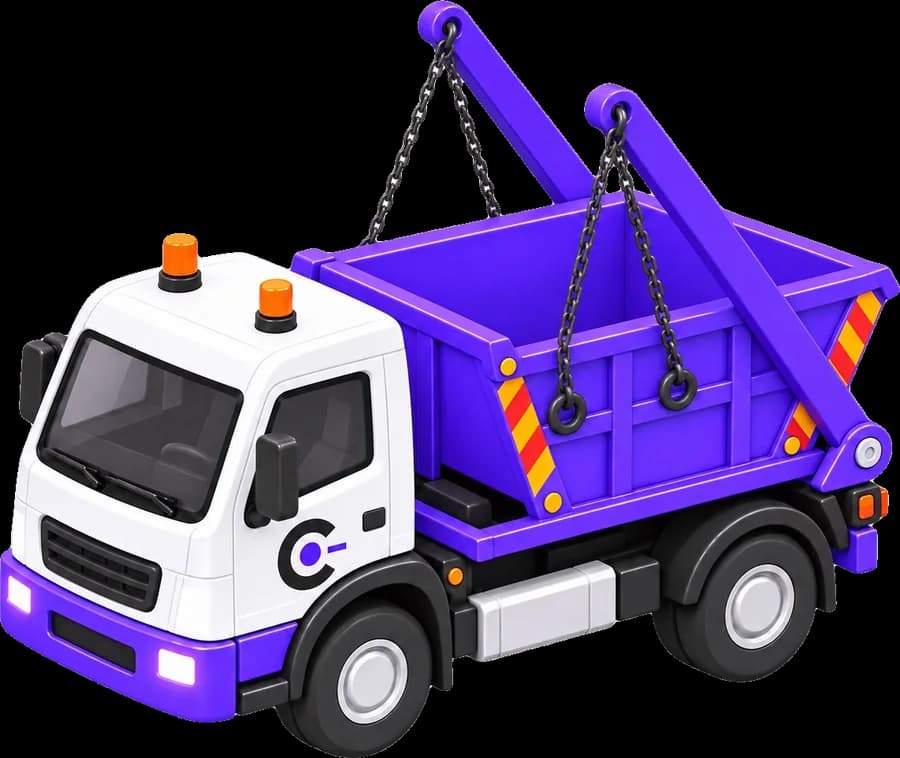
Is this the right thing to order?
Usually. Not always.
A skip suits most jobs that fill over a few days. For some, another service does it better — and for less.
A skip is right for
- Clear-outs, renovations and building work
- Waste that builds up over days, not one load
- Room on a drive — or the road, with a permit we arrange
Choose your size
Choose your skip size.
Our guide uses approximate external dimensions and capacities. If you are between sizes, choosing the larger option normally costs less than arranging a second collection.

4 Yard Skip
~40 bin bags
- Length
- 2.6 m
- 8ft 6in
- Width
- 1.77 m
- 5ft 10in
- Height
- 1.0 m
- 3ft 3in
- Best for
- Small clear-outs
- Good to know
- Takes heavy waste — hardcore and soil

6 Yard Skip
~60 bin bags
- Length
- 3.39 m
- 11ft 1in
- Width
- 1.87 m
- 6ft 2in
- Height
- 1.0 m
- 3ft 3in
- Best for
- Renovation waste
- Good to know
- Takes heavy waste — hardcore and soil

8 Yard Skip
~80 bin bags
- Length
- 3.73 m
- 12ft 3in
- Width
- 1.86 m
- 6ft 1in
- Height
- 1.25 m
- 4ft 1in
- Best for
- Building projects
- Good to know
- Takes heavy waste — hardcore and soil

8 Yard Enclosed Skip
~80 bin bags
- Length
- 3.73 m
- 12ft 3in
- Width
- 1.86 m
- 6ft 1in
- Height
- 1.25 m
- 4ft 1in
- Best for
- Building projects
- Good to know
- Takes heavy waste — hardcore and soil

12 Yard Skip
~120 bin bags
- Length
- 4.0 m
- 13ft 1in
- Width
- 1.68 m
- 5ft 6in
- Height
- 1.83 m
- 6ft
- Best for
- Large clearances
- Not suitable for
- Not suitable for hardcore / rubble, soil / subsoil (an 8-yard skip or smaller).
12 Yard Enclosed Skip
~120 bin bags
- Length
- 4.0 m
- 13ft 1in
- Width
- 1.68 m
- 5ft 6in
- Height
- 1.83 m
- 6ft
- Best for
- Large clearances
- Not suitable for
- Not suitable for hardcore / rubble, soil / subsoil (an 8-yard skip or smaller).

16 Yard Skip
~160 bin bags
- Length
- 4.47 m
- 14ft 8in
- Width
- 1.8 m
- 5ft 11in
- Height
- 2.0 m
- 6ft 7in
- Best for
- Major clearances
- Not suitable for
- Not suitable for hardcore / rubble, soil / subsoil (an 8-yard skip or smaller).
1 of 7
A guide price for a private-property (driveway) delivery with general mixed waste, at a London postcode — prices can differ by area, so enter your postcode for yours.
Bag counts assume full 60-litre bin bags — about 10 to a cubic yard. Bulky items take more room than bags.
What goes in
What goes in a skip.
Almost everything. A few items are declared when you book, and a few never go in.

Goes straight in
9 itemsPick the closest waste type when you book — mixed loads are the most common.
- General / Mixed Waste
- Mixed Construction & Demolition
- Soil / Subsoilup to 8 yd
- Hardcore / Rubbleup to 8 yd
- Wood
- Green / Garden Waste
- Metal
- Plasterboardin a skip of its own
- Cardboard / Paper
Tagged waste is heavy, so it goes in the smaller skips only.
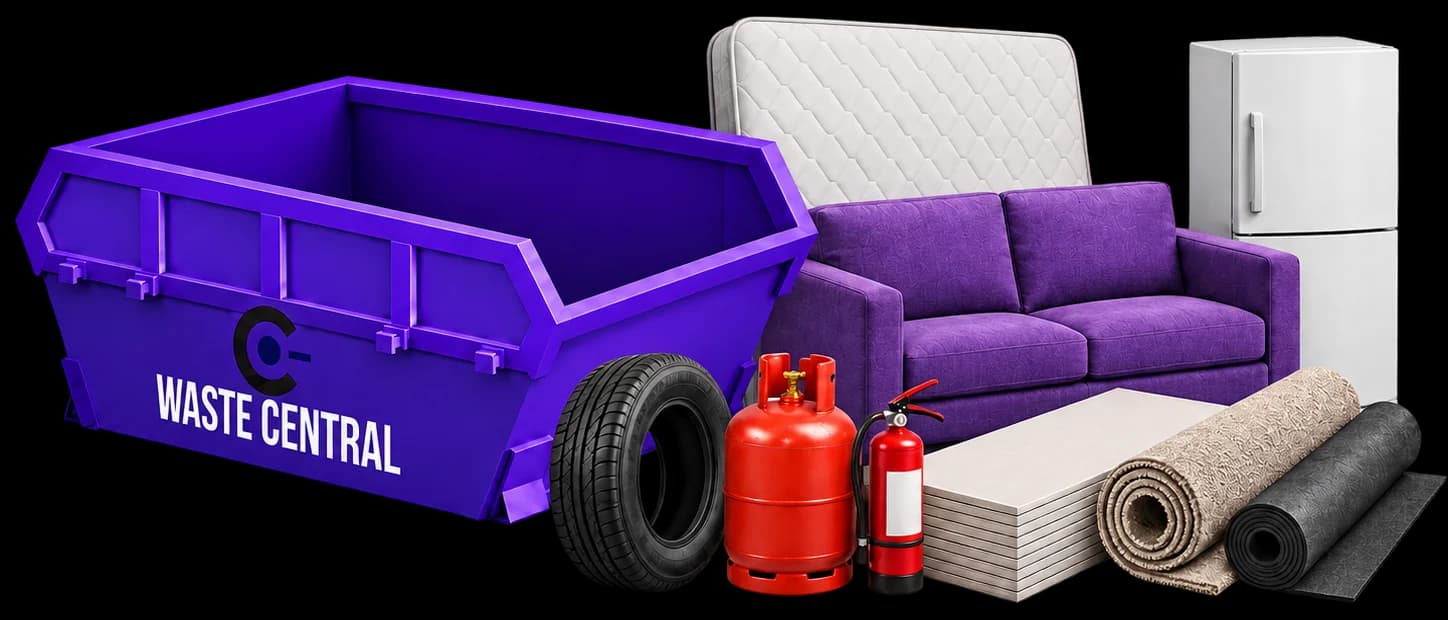
Declare when you book
6 itemsThese items are priced on top of the skip.
- Car Tyre
- Commercial Fridge
- Domestic Fridge
- Double Mattress
- Mattress
- POPs upholstered furniture
Carpet and roofing felt are fine in small amounts; more than about a tenth of the load is charged. Anything else? Tell us before you book.
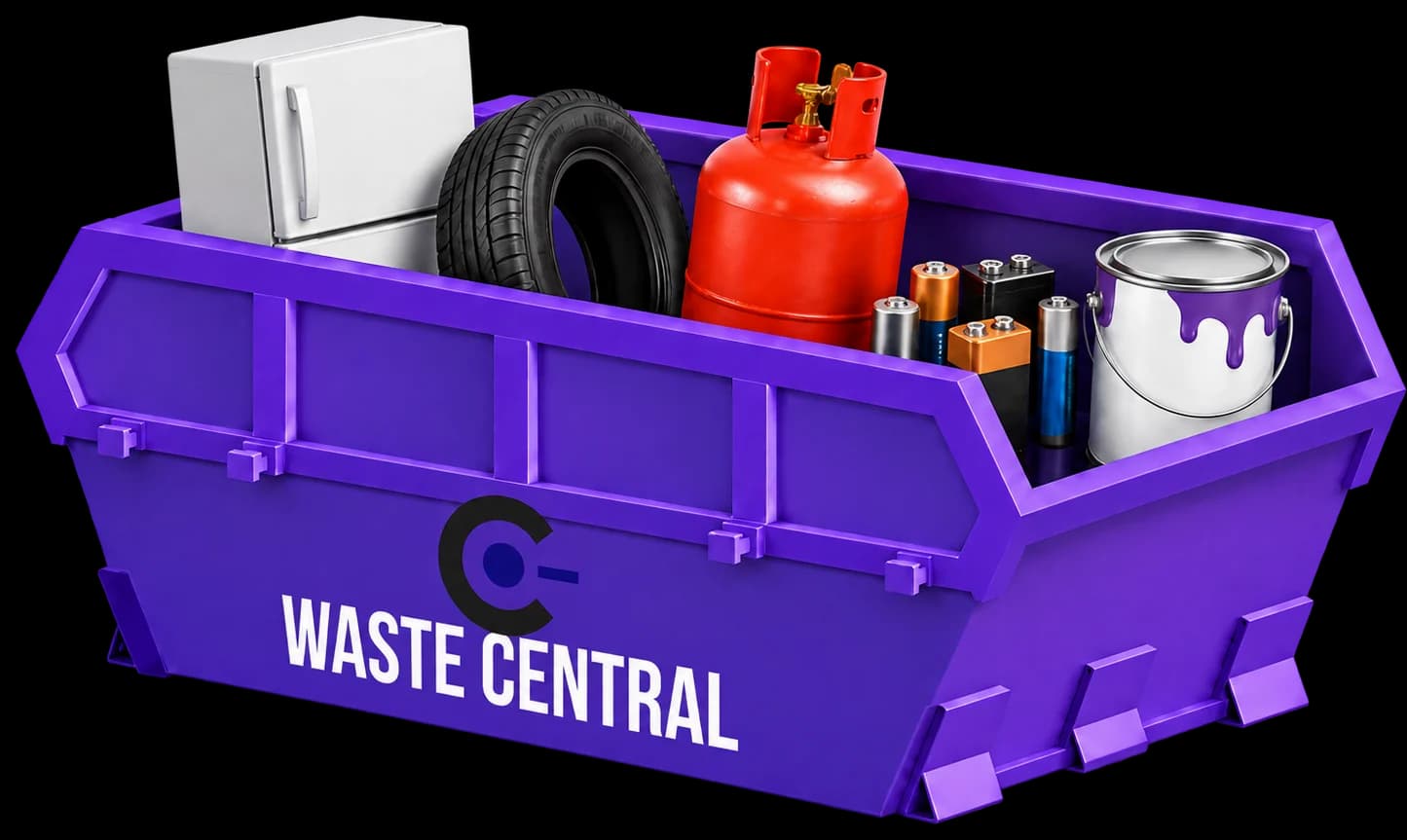
Never goes in
8 itemsDisposing of these is a separate service — contact us.
- Asbestos
- Explosives, flares and ammunition
- Clinical or medical waste
- Animal or human waste
- Loose or leaking liquids, solvents and chemicals
- Fuels and oils
- Treated railway sleepers and lead-painted timber
- Household and lithium batteries
Restricted doesn't always mean no: Fridges, freezers and tyres can go in once declared. Paint in its tin — ask first. Tell us what you have.
Load it right
Keep it safe. Keep it level.
Do
- Load only what you booked. Ask us first if you're unsure.
- Keep it level with the sides. Heavier items at the bottom.
- Declare chargeable items when you book. Each is priced before you pay.
- Keep access clear. Room for the lorry to lift it.
- Tell us if it goes on the road. We arrange the council permit.
Don’t
- Don’t overfill it. Nothing above the rim — an overfilled skip can't be sheeted or taken.
- Don’t hide restricted items. A load that isn't what was booked can be refused, and charged.
- Don’t mix plasterboard into a general load. It goes in a skip of its own.
- Don’t burn waste or move the skip yourself. Only the lorry lifts a skip.
- Don’t block the collection route. Keep vehicles, gates and materials clear.
Access & siting
Will it fit where you want it?
What stops a delivery is rarely the price — it's the way in. A skip lorry needs four things.
- A straight run, about 12 m long and 3 m wideThe skip comes off the back on chains, in line with the lorry — it can't be swung sideways into a gap.
- About 4.5 m clear overheadThe arms lift above the cab — no lifting under or near power lines. Cables, branches or a carport roof over the spot? Tell us before you book.
- Firm, level groundA loaded skip is several tonnes on a short wheelbase — soft verges and block paving are where it goes wrong.
- On the road? A council permitWe look up the fee for your road and show it while you book.
Typical figures for UK vehicles, not a specification — lorries vary.
How it works
Booked in minutes. Collected when you're done.
No collection date needed when you book — we email you a calendar, and you pick the day.
1. Book the drop
Choose the size and the delivery day. Know your collection date? Add it now.
2. Fill it at your pace
Level with the sides, nothing that never goes in.
3. We email you a calendar
Tap the collection day; we confirm it with the supplier.
Need longer? No problem — there's no fixed hire period and no extra hire charge; a skip on the road may need its permit extended.
How it's priced
One price for the job.
Delivery, hire and collection
All in the price of the size you book — no separate collection to buy later.
The permit, if it's on the road
Priced for your street before you pay, and we apply to the council for you. If we can't price your council online, our team sorts the permit with you.
Extras, declared when you book
Anything that needs declaring is priced before you pay, never found on the invoice.
Questions
Skip hire, answered.
How long can I keep the skip?
There is no fixed hire period. Book online without a collection date and we get in touch to arrange a day that suits you — and when you finish, just tell us. Days on site while we arrange your collection aren't charged as extra hire. If you need it longer, tell us and we'll move the collection to a later day — the extra time isn't charged as hire. If it stands on a public road, its council permit has to cover the extra time too: we arrange the extension, and its cost — the council's fee and any charge for arranging it — is billed separately. For a consumer the hire cannot run beyond three months in total.
Do I need to be there when the skip is delivered?
Not usually. If the drop spot is clear and you have said where it goes, the driver can deliver without anybody present — the delivery instructions travel with the booking rather than sitting in somebody's inbox. Access matters more than attendance: the lorry needs room to pull alongside and swing the container down, so a car parked across the spot will stop the delivery even if you are standing next to it. If the placement is awkward, or the only route in is through a gate or a shared yard, being there for five minutes is worth it.
Do I need a permit for my skip?
Only if it stands on a public road. On your own driveway or private land, no permit is needed and the question never comes up. On the road, the permit is shown as its own line while you book, and it is applied for on your behalf — by us or by the carrier — so you never contact the council. Councils work in working days and each sets its own notice period. If the date you choose is too tight for yours, some councils will take an urgent application for a late fee; where yours will not, we will tell you and move the delivery to a date that works, rather than letting a skip arrive without a permit under it.
Which skip size do I need?
As a rough guide: a 4-yard skip suits a garden tidy-up, a small DIY job or a bathroom strip-out; a 6-yard skip a small kitchen strip-out; an 8-yard builders skip most home-improvement work; and a 12- to 16-yard skip bulky but light clearances such as furniture and packaging. The common mistake is sizing on volume alone — with heavy waste you reach the weight limit long before the container looks full, which is why soil / subsoil and hardcore / rubble are capped at 8 yards. If you are unsure, describe the job and we will point you at the right one.
How full can I fill a skip, and what happens if it is overfilled?
Level with the top rim, and no higher. An overloaded container cannot legally be carried on the road, because the load has to be sheeted or netted and nothing may project above the sides — so a driver who finds one heaped over the top may not be able to take it. That is a wasted journey, charged at £60 under the terms, and the skip stays until the load has been levelled — so overfilling costs more than it saves. Weight is the other limit, and with heavy waste it is the one you meet first, which is why soil / subsoil and hardcore / rubble are capped at 8 yards.
Do I get paperwork for my waste, and what is a waste transfer note?
Yes — a waste transfer note is sent to you for every load and filed against your booking. It is the document recording a load of waste changing hands: what it was, who produced it, who carried it, and where the transfer happened. Under the Environmental Protection Act 1990 whoever produces waste has a duty of care for it, and so does each business that carries, keeps or disposes of it, or arranges that as a broker; the transfer note is how you demonstrate you discharged yours. No broker or carrier can take that responsibility off you, and anyone claiming they can is selling something they cannot deliver. What we can do is make sure the evidence exists without you chasing it, so the paperwork is assembled before anybody asks for it.
Prices shown are starting prices including VAT and exclude optional extras. Your exact price depends on your waste type and where the container goes — price your own postcode.
Dimensions are the build measurements of a real container range, and yardages are nominal — an individual supplier's body can differ slightly. See our Terms of Hire for full details.
Ready to get waste sorted?
Enter your delivery postcode to see prices for your address, or contact our team if you would like help choosing.